
Showing posts with label Simulation and Modeling. Show all posts
Showing posts with label Simulation and Modeling. Show all posts
Matlab 13 Codes for Simulation and Modeling
There are most important Matlab codes for Simulation and Modeling Course. These codes are done by me and with some of my friends. Error's are not impossible. See these codes for Simulation and modeling course.
[Having any error, please comment]
- Mid Square Random Number Generator Matlab code
- Residue Method / Mixed Multiplicative Random Number Generator Matlab code
- Additive Congruential Random Number Generator Matlab code
- Multiplicative Congruential Random Number Generator Matlab code
- Arithmetic congruential Method Random Number Generator Matlab code
- Binomial Distribution Matlab code
- Poison Distribution Matlab code
- Chi Square Test for a given set of random numbers
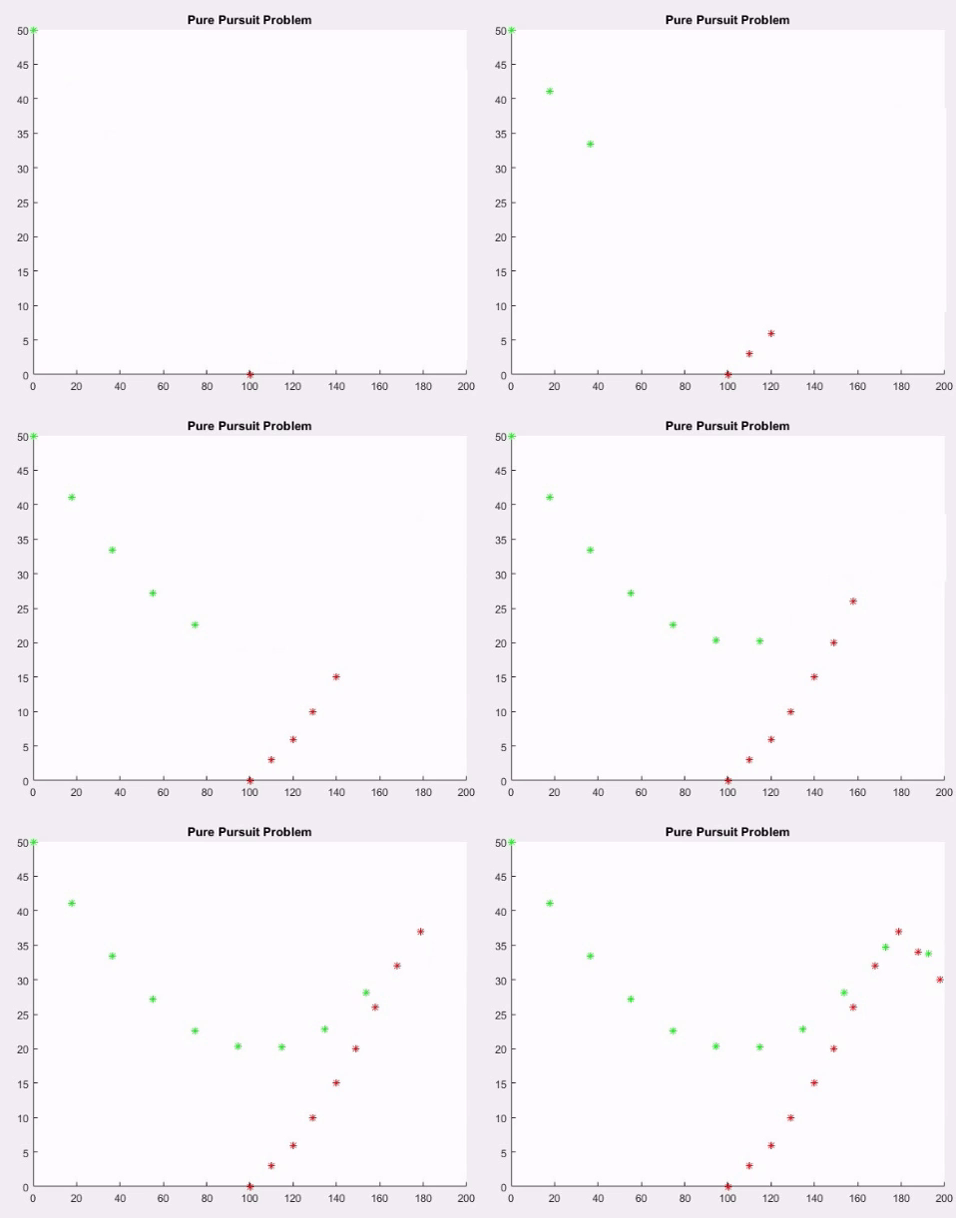
- Monte Carlo - Pure Pursuit Code For Matlab
- Monte Carlo - Gambling Game Code For Matlab
- Monte Carlo - Monte Carlo Integration Code For Matlab
- Monte Carlo - Monte Carlo Pi Code For Matlab
- Single Server Queuing System Matlab Code
Mid Square Method Random Number Generator Code
totalNumber = input('Number of Random Numbers want to generate : ');
choose = input('Enter the seed : ');
disp('Total Random Numbers are : ');
for i = 1:totalNumber
    random = choose ^ 2;
    random = random / 100; % Find the dividend
    random = rem(random, 10000); % Get the reminder;
    choose = random;
    fprintf('%.2f ', random);
end
fprintf('\n');
Output Mid square random Number generator:

Residue Method / Mixed Multiplicative Random Number Generator Code
clc;
a=input('Please Enter the value of a : ');
b=input('Please Enter the value of b : ');
m=input('Please Enter the value of m : ');
r=input('Please Enter the value of seed or r : ');

totalNumber = input('Number of Random Numbers want to generate : ');

for i = 1:totalNumber
    r = mod(a*r +b, m);
    fprintf('%4.0f ', r);
end
fprintf('\n');
Output Residue Method random Number generator:

Additive Congruential Method Random Number Generator Code
Same as residue method in this case just a = 1 and hence rules changed
%% r(i+1) = (r(i) + b) mod m
clc;
b=input('Please Enter the value of b : ');
m=input('Please Enter the value of m : ');
r=input('Please Enter the value of seed or r : ');

totalNumber = input('Number of Random Numbers want to generate : ');

for i = 1:totalNumber
    r = mod(r +b, m);
    fprintf('%4.0f ', r);
end
fprintf('\n');
Output Additive Congruential Method random Number generator:

Multiplicative Congruential Method Random Number Generator Code
Same as residue method in this case just b = 0 and hence rules changed
%% r(i+1) = (ar(i)) mod m
clc;
a=input('Please Enter the value of a : ');
m=input('Please Enter the value of m : ');
r=input('Please Enter the value of seed or r : ');

totalNumber = input('Number of Random Numbers want to generate : ');

for i = 1:totalNumber
    r = mod(a*r, m);
    fprintf('%4.0f ', r);
end
fprintf('\n');
Output Multiplicative Congruential Method random Number generator:

Arithmetic congruential Random Number Generator Code
%% r(i + 1) = (r(i) + r(i - 1)) percent m
clc;
N = input('Enter How Many Number You want to generate = ');
r0 = input('Enter First Random Number = ');
r1 = input('Enter Second Random Number = ');
m = input('Enter Maximum Range Of Random Number = ');

for i = 1:N
    r2 = r0 + r1;
    random = mod(r2, m);
    fprintf('%d ', random);
    r0 = r1;
    r1 = r2;
end
Output Arithmetic congruential random Number generator:

Binomial Distribution Code
clc;
trial = input ('Type the number of trial = ');
p = input('Type the value of p(<1.0) the probability of success = ');
variate = input('Type the number of variates to be generated = ');
fprintf('Here,You gave \t Number of trial = %d, Probability of success =  %d\nNumber of variates = %d\n',trial,p,variate);
x = 0;  n = trial;
for i = 1:n
    y = rand();
    if(y<p)
        x = x+1;
    end
    fprintf('x = %d\n', x);
end
Output Binomial Distribution :

Poison Distribution Code
clc;
lamda_value = input('Value of Lamda = ');
number_values = input('Number Of Values = ');


for i=1:number_values
   count = 0;
   p = 0;
   fact = 1;
   y = rand;
   while(y > p)
        prob = (power(lamda_value,count)*power(2.718282,-lamda_value))/fact;  %Use the poison rules
        p = p + prob;
        count = count + 1;
        fact = fact * count;
   end
   fprintf('%.f\t',count);
   fprintf('\n');
end
fprintf('\n');
Output Poison Distribution :

Chi Square Test for a given set of random numbers Matlab Code
clc;
r = [36 91 51 02 54 06 58 06 58 02 54 01 48 97 43 22 83 25 79 95 42 87 73 17 02 42 95 38 79 29 65 09 55 97 39 83 31 77 17 67 62 03 49 90 37 13 17 58 11 51 92 33 78 21 66 09 54 49 90 35 84 26 74 22 62 12 90 36 83 32 75 31 94 34 87 40 07 58 05 56 22 58 77 71 10 73 23 57 13 36 89 22 68 02 44 99 27 81 26 85 ];
r_length = length(r);
fprintf('Total Students = %d\n', r_length);
for i = 1:r_length
    fprintf(' %d ', r(i));
end
fprintf('\n');

Acceptance_value = input('Enter acceptance value at that confidence level = ');
Expected = input('Enter Expected value = ');
E = Expected;
Range = Expected * Expected;
frequency = 0;
diff_square = 0;
i = 0;


while i < Range
    for j = 1:r_length
        if((r(j) > i) && (r(j) <= Expected))
            frequency = frequency + 1;
        end
    end
     O = frequency;
     diff_square = diff_square + (abs(O - E)) ^ 2;

    fprintf('Difference Square = %d\n', frequency);
    i = i + E;
    Expected = Expected + E;
    frequency = 0;
end
 chi_square = double(diff_square / E);
 fprintf('\n\nChi Square value is = %f\n', chi_square);

 if (Acceptance_value > chi_square)
     fprintf('\nThe random numbers follows the chi-square test. Because Chi Square value %.2f is less than Acceptance value %.2f\n', chi_square, Acceptance_value);
 else
     fprintf('\nThe random numbers follows the chi-square test. Because Chi Square value %.2f is greater than Acceptance value %.2f\n', chi_square, Acceptance_value);
 end

 fprintf('\n\n');
Output Chi Square Test Code :

Monte Carlo - Pure pursuit Bombers and Fighters Matlab Code
clc;
hold all;
xb=[100 110 120 129 140 149 158 168 179 188 198 209 219 226 234 240];
yb=[0 3 6 10 15 20 26 32 37 34 30 27 23 19 16 14];

xf = [];
yf = [];
xf(1)=0;
yf(1)=50;
s=20;
dist=0;

for i=1:15
   pause on;
    plot(xb(i),yb(i),'r*');
    title('Pure Pursuit Problem');
    pause(1);
    plot(xf(i),yf(i),'g*');
    y=yb(i)-yf(i);
    x=xb(i)-xf(i);

  dist=sqrt(y^2+x^2);

  if(dist<=12)
        fprintf('Bomber destroyed at  %d s',i);
        break;
  end

  xf(i+1)=xf(i)+s*((xb(i)-xf(i))/dist);
  yf(i+1)=yf(i)+s*((yb(i)-yf(i))/dist);
end
Output Monte Carlo - Pure Pursuit Bombers and fighters Code :
Bomber destroyed at 11 s>>
Gambling Game - Monte Carlo Matlab Code
clc;
n = input('How many time you want to play the game : ');

difference = 0;
tail = 0;
head = 0;

fprintf('\n---------------------------------------------------------------\n');
fprintf('Game No.\tSl No.\tRandom Number\tHeads\tTails\tDifference');
fprintf('\n---------------------------------------------------------------\n');

for i = 1:n
    j = 1;

    while 1
        toss = int8((10-0)*rand(1) + 0); %Generate a random number between 0 to 10%

        if (toss > 4)
            tail = tail + 1;
        else
            head = head + 1;
        end

        difference = abs((head - tail));
        fprintf('\n\t%d\t\t%d\t\t\t%d\t\t\t%d\t\t%d\t\t%d\t\t%d', i, j, toss, head, tail, difference);

        if(difference == 3) %The rules of the Gambling - If difference = 3 then Count the lose or won coins
            result = 8 - j;
            if(result < 0)
                fprintf('\n\t\tYou lose %d coins\n', abs(result));
            else
                fprintf('\n\t\tYou won %d coins\n', abs(result));
            end
            break;
        end
        j = j + 1;
    end % End while
end  % End For
Output Gambling Game - Monte Carlo Matlab Code :

Monte Carlo Integration - Monte Carlo Matlab Code
clc;
max_dot = input('How many times do you want to put dot : ');

inside = 0;
a = input('Enter a : ');
b = input('Enter b : ');
h = input('Enter h : ');

%Draw Plot
for x = 1: .01:10
    y = x^3;
    plot(x,y, 'y.');
    hold on;
end

for i = 1:max_dot
    x = a + rand * (b-a);
    y = rand * h;

    if y <= x^3
        inside = inside+1;
        plot(x,y, 'r.');
    else
        plot(x,y, 'g.');
    end

    hold on;
end

integration = (inside/max_dot) * ((b-a) * h);
fprintf('\nIntegration is : %f\n', integration);
Output Monte Carlo Integration - Monte Carlo Matlab Code :

Monte Carlo Pi - Monte Carlo Matlab Code
clc;
maximum_dot = input('How many times want to put Dot : ');
inside = 0;
a = input('Enter a : ');
b = input('Enter b : ');
h = input('Enter h : ');

for i = 1:maximum_dot
    x = rand;
    y = rand;
    if sqrt(x^2 + y^2) <= 1
        plot(x,y,'r.');
        inside = inside + 1;
    else
        plot(x,y,'b.');
        hold on;
    end
end

fprintf('Pi = %f\n', inside / maximum_dot * 4);
Output Monte Carlo Pi - Monte Carlo Matlab Code :

Code - Single Server Queuing System Matlab Code
total=0; busy=0;
%a=randi([0 8],1,8);
 a=[.4 1.6 2.1 3.8 4.0 5.6 5.8 7.2];
a_length=length(a);
arr=zeros(a_length);

%d=randi([0 9],1,5);
d=[2.4 3.1 3.3 4.9 8.6];
b=union(a,d);
l=length(b);
a_t=0;d_t=0;q=0;
axis([0 b(length(b))+1 0 length(a)]);


%Queue delay Time
figure(1);
title('Queue Delay Time');
for i=1:l-1
   a_m=ismember(a,b(i));
   d_m=ismember(d,b(i));
   if sum(a_m)>=1
       a_t=a_t+1;
   end
   if sum(d_m)>=1
       d_t=d_t+1;
   end
   dif=a_t-d_t;
   if dif>1
       rectangle('Position',[b(i) 0 b(i+1)-b(i) dif-1],'FaceColor',[1 0 0]);
       arr(dif)=arr(dif)+(b(i+1)-b(i));
   end
   if dif>0
       busy=busy+(b(i+1)-b(i));
   end
end


%Server Busy Time
b_t=0;
figure(2);
title('Server Busy Time');
axis([0 b(length(b))+1 0 length(a)]);
for i=1:l-1
   a_m=ismember(a,b(i));
   d_m=ismember(d,b(i));
   if sum(a_m)>=1
       b_t=b_t+1;
   end
   if sum(d_m)>=1
       b_t=b_t-1;
   end
   if b_t>0
       rectangle('Position',[b(i) 0 b(i+1)-b(i) 1],'FaceColor',[0 1 0]);
   end
end
for i=1:a_length
    total=total+arr(i)*(i-1);
end


disp(total);
disp(total/d(length(d)));


disp(busy);
disp(busy/d(length(d)));
Output Single Server Queuing System Matlab Code

Tags:
Mid Square Random Number Generator Matlab code,Residue Method / Mixed, Multiplicative Random Number Generator Matlab code, Additive Congruential Random Number Generator Matlab code, Multiplicative Congruential Random Number Generator Matlab codeArithmetic congruential Method Random Number Generator Matlab code , Binomial Distribution Matlab code, Poison Distribution Matlab code ,Chi Square Test for a given set of random numbers, Monte Carlo - Pure Pursuit Code For Matlab, Monte Carlo - Gambling Game Code For Matlab, Monte Carlo - Monte Carlo Integration Code For Matlab, Monte Carlo - Monte Carlo Pi Code For Matlab, Single Server Queuing System Matlab Code
Gambling Game Code Implementation in Matlab and C - Simulation
Problem:
Write the gambling game code in Matlab.Logic / Algorithm for Gambling game code:
Initialize head = 0, tail = 0, difference = 0
while (1)
toss the coin and make value from 0 to 10 using reminder
  if (toss > 4)
     tail = tail + 1
  else
     head = head + 1
  take difference = head - tail
  if (difference == 3)
    result = 8 - upto_time
    if (result < 0)
       lose
    else
       won
  else
Gambling game Code in Matlab
clc;
n = input('How many time you want to play the game : ');

difference = 0;
tail = 0;
head = 0;

fprintf('\n---------------------------------------------------------------\n');
fprintf('Game No.\tSl No.\tRandom Number\tHeads\tTails\tDifference');
fprintf('\n---------------------------------------------------------------\n');

for i = 1:n
    j = 1;

    while 1
        toss = int8((10-0)*rand(1) + 0); %Generate a random number between 0 to 10%

        if (toss > 4)
            tail = tail + 1;
        else
            head = head + 1;
        end

        difference = abs((head - tail));
        fprintf('\n\t%d\t\t%d\t\t\t%d\t\t\t%d\t\t%d\t\t%d\t\t%d', i, j, toss, head, tail, difference);

        if(difference == 3) %The rules of the Gambling - If difference = 3 then Count the lose or won coins
            result = 8 - j;
            if(result < 0)
                fprintf('\n\t\tYou lose %d coins\n', abs(result));
            else
                fprintf('\n\t\tYou won %d coins\n', abs(result));
            end
            break;
        end
        j = j + 1;
    end % End while
end  % End For
Output Gambling game Code in Matlab

Gambling game Code in C Language
#include<stdio.h>
#include<stdlib.h>

int main()
{
    int tail,head,i,n,j,difference=0,result,toss;
    printf("How many time you want to play ? ");
    scanf("%d",&n);
    printf("\n");

    tail = 0;
    head = 0;

    printf("Serial \t Head: \t Tail: \t Difference: \t\n");

    for(i=1; i<=n; i++)
    {
        j = 1;


        while(1)
        {
            // taking random number
            toss = rand() % 10;
            if(toss > 4)
            {
                // if(5,6,7,8,9) then tail will increase
                tail = tail + 1;
            }
            else
            {
                // if(,1,2,3,4) then head will increase
                head = head + 1;
            }
            // difference between head and tail
            difference = abs((head - tail));
            printf("%d\t%d\t%d\t%d\n",j,head,tail,difference);
            if(difference == 3)
            {
                // counting result suppose the difference match after 10 step then difference = 8-10=2
                result = 8 - j;
                if(result < 0)
                {
                    // if answer negative then you are in lose this is the amount of losed coin
                    printf("You lose %d Coin\n",abs(result));
                }
                else
                {
                    // if answer positive then you are in benefit this is the amount of benefited/win coin
                    printf("You win %d Coin\n",abs(result));
                }
                break;
            }
            // increament the count like serial number
            j++;
        }
    }
    return 0;
}
Gambling game Code in C Language Output

Tags:
Gambling Game Code Implementation in Matlab and C - Simulation, Gambling Matlab code, Gambling game C code, gambling game code implementation, gambling gamePure Pursuit Problem Code - Matlab and C code of Pure pursuit problem
What is Pure pursuit:
Pure pursuit is a type of pursuit curve used in aerial combat in which an aircraft pursues another aircraft by pointing its nose directly towards it.
What is mainly Pure pursuit is:
Logic Behind the pure pursuit problem of simulation:- Bomber Aircraft and a Fighter Aircraft are flying in the a horizontal plane.
- Fighter aircraft and bomber aircraft both are moving inside the rectangular range.
- The fighters and bombers have a velocity given, suppose s = 20 in our code.
- When the distance of the Bomber and the Fighter is less than 12 units, it is assumed that the Bomber is shot down or destroyed.
- The distance between this the bombers and fighter follows the distance rule - dist[t] = √( (yb[t]-yf[t])² + (xb[t]-yf[t])² ).
- In matlab the distance will be dist = sqrt(y^2+x^2).
- Look the pure pursuit problem code now and hope it'll clear to you.

Pure Pursuit Problem MatLab Code
clc;
hold all;
xb=[100 110 120 129 140 149 158 168 179 188 198 209 219 226 234 240];
yb=[0 3 6 10 15 20 26 32 37 34 30 27 23 19 16 14];

xf = [];
yf = [];
xf(1)=0;
yf(1)=50;
s=20;
dist=0;

for i=1:15
   pause on;
    plot(xb(i),yb(i),'r*');
    title('Pure Pursuit Problem');
    pause(1);
    plot(xf(i),yf(i),'g*');
    y=yb(i)-yf(i);
    x=xb(i)-xf(i);

  dist=sqrt(y^2+x^2);

  if(dist<=12)
        fprintf('Bomber destroyed at  %d s',i);
        break;
  end

  xf(i+1)=xf(i)+s*((xb(i)-xf(i))/dist);
  yf(i+1)=yf(i)+s*((yb(i)-yf(i))/dist);
end
Pure Pursuit Problem Output - Matlab:
>> Bomber destroyed at 11 s
>>
Pure Pursuit problem in C language:
Code:
#include < stdio.h >
#include < math.h >
#include < stdlib.h >

void main()
  {
   float xf,yf, xb,yb,d,distance;
   int flag=0,
   vf=20,
   time=0;
   randomize();
   xf=rand()%1001;
   yf=rand()%1001;
   xb=rand()%1001;
   yb=rand()%1001;
   while(flag==0)
    {
 d= (yb-yf)*(yb-yf)+(xb-xf)*(xb-xf);
 distance=sqrt(d);
 printf("time=%d   xf=%5.2f  yf=%5.2f  xb=%5.2f  yb=%5.2f  distance=%5.2f\n\n",time,xf,yf,xb,yb,distance);
 if(distance >100)
   {
    printf("The bomber plain was shot down at %d second\n",time);
    flag=1;
   }
 else if(distance>900)
   {
     printf("The bomber plane escaped from sight at %d second\n", time);
     flag=1;
   }
 else
   {
     xf=xf+vf*(xb-xf)/distance;
     yf=yf+vf*(yb-yf)/distance;
     xb=rand()%1001;
     yb=rand()%1001;
     time=time+1;
   }
    }
    getch();
}
Output C code Pure Pursuit:
CASE 1:  BOMBER  IS SHOT DOWN BY FIGHTER

time=0   xf=688.00  yf=796.00  xb=366.00  yb=119.00  distance=749.68

time=1   xf=679.41  yf=777.94  xb=563.00  yb=771.00  distance=116.62

time=2   xf=659.45  yf=776.75  xb=419.00  yb=939.00  distance=290.07

time=3   xf=642.87  yf=787.94  xb=87.00  yb=931.00  distance=573.98

time=4   xf=623.50  yf=792.92  xb=960.00  yb=247.00  distance=641.30

time=5   xf=633.99  yf=775.90  xb=197.00  yb=203.00  distance=720.54

time=6   xf=621.86  yf=759.99  xb=799.00  yb=891.00  distance=220.32

time=7   xf=637.94  yf=771.89  xb=207.00  yb=310.00  distance=631.70

time=8   xf=624.30  yf=757.26  xb=193.00  yb=915.00  distance=459.24

time=9   xf=605.52  yf=764.13  xb=311.00  yb=991.00  distance=371.76

time=10   xf=589.67  yf=776.34  xb=816.00  yb=304.00  distance=523.76

time=11   xf=598.31  yf=758.30  xb=804.00  yb=587.00  distance=267.68

time=12   xf=613.68  yf=745.50  xb=122.00  yb=530.00  distance=536.84

time=13   xf=595.36  yf=737.47  xb=924.00  yb=705.00  distance=330.24

time=14   xf=615.27  yf=735.51  xb=100.00  yb=508.00  distance=563.26

time=15   xf=596.97  yf=727.43  xb=48.00  yb=39.00  distance=880.51

time=16   xf=584.50  yf=711.79  xb=990.00  yb=710.00  distance=405.50

time=17   xf=604.50  yf=711.70  xb=523.00  yb=629.00  distance=116.11

time=18   xf=590.46  yf=697.46  xb=894.00  yb=148.00  distance=627.72

time=19   xf=600.13  yf=679.95  xb=463.00  yb=537.00  distance=198.09

time=20   xf=586.29  yf=665.52  xb=308.00  yb=709.00  distance=281.67

time=21   xf=566.53  yf=668.61  xb=488.00  yb=605.00  distance=101.06

time=22   xf=550.99  yf=656.02  xb=107.00  yb=522.00  distance=463.77

time=23   xf=531.84  yf=650.24  xb=305.00  yb=777.00  distance=259.86

time=24   xf=514.38  yf=659.99  xb=250.00  yb=794.00  distance=296.40

time=25   xf=496.54  yf=669.04  xb=448.00  yb=950.00  distance=285.13

time=26   xf=493.14  yf=688.74  xb=252.00  yb=285.00  distance=470.27

time=27   xf=482.88  yf=671.57  xb=623.00  yb=646.00  distance=142.43

time=28   xf=502.56  yf=667.98  xb=640.00  yb=327.00  distance=367.64

time=29   xf=510.03  yf=649.43  xb=357.00  yb=811.00  distance=222.54

time=30   xf=496.28  yf=663.95  xb=623.00  yb=353.00  distance=335.78

time=31   xf=503.83  yf=645.43  xb=156.00  yb=371.00  distance=443.06

time=32   xf=488.13  yf=633.04  xb=533.00  yb=117.00  distance=517.99

time=33   xf=489.86  yf=613.12  xb=301.00  yb=627.00  distance=189.37

time=34   xf=469.91  yf=614.59  xb=143.00  yb=263.00  distance=480.09

time=35   xf=456.29  yf=599.94  xb=780.00  yb=654.00  distance=328.19

time=36   xf=476.02  yf=603.23  xb=928.00  yb=422.00  distance=486.96

time=37   xf=494.58  yf=595.79  xb=757.00  yb=44.00  distance=611.01

time=38   xf=503.17  yf=577.73  xb=734.00  yb=192.00  distance=449.52

time=39   xf=513.44  yf=560.57  xb=49.00  yb=949.00  distance=605.47

time=40   xf=498.10  yf=573.40  xb=515.00  yb=893.00  distance=320.05

time=41   xf=499.16  yf=593.37  xb=111.00  yb=765.00  distance=424.41

time=42   xf=480.87  yf=601.46  xb=463.00  yb=633.00  distance=36.25

The bomber plain was shot down at 42 second

CASE 2: BOMBER  ESCAPES FROM  THE SIGHT OF FIGHTER

time=0   xf=642.00  yf=902.00  xb=788.00  yb=709.00  distance=242.00

time=1   xf=654.07  yf=886.05  xb=585.00  yb=997.00  distance=130.69

time=2   xf=643.50  yf=903.03  xb=587.00  yb= 6.00  distance=898.81

time=3   xf=642.24  yf=883.07  xb=11.00  yb=162.00  distance=958.33

The bomber plane escaped from sight at 3 second
Links Where you can learn more on Pure pursuit problem:
- Wikipedia - Pure Pursuit
- Mathworks - Pure Pursuit
Tags:
Pure Pursuit Problem Code - Matlab and C code of Pure pursuit problem, Pure pursuit problem, Pure pursuit problem code, pure pursuit solution in c language, pure pursuit simulation, pure pursuit logic, pure pursuit algorithm, pure pursuit learning, pure pursuit explanation,Single Server Queuing System - MatLab and C code Implementation
What:
A single server queuing system is the waiting lines or queues in that system. A single server queuing system can tell us the following things-- How many times a user need to wait in waiting & Total waiting time
- How many times user take in service time & Total service time
- How many users are in the Queue & Total queue time
- How many users has completed their work in that system yet.

Where Single server queuing system is used
Single server queuing system is applied almost all the fields in real life. Like,- In banking system, taking money from the bank. User needs to stand in a line and take money one by one
- A Bus, plane ticketing system
- Any system with line and who needs to put user in the queue
Real time example of a server queuing system - Patient Data:
 |
| Single Server Queuing Example of patient and doctor |
Single Server Queuing MatLab Code implementation without input (with figure):
Code
total=0; busy=0;
%a=randi([0 8],1,8);
 a=[.4 1.6 2.1 3.8 4.0 5.6 5.8 7.2];
a_length=length(a);
arr=zeros(a_length);

%d=randi([0 9],1,5);
d=[2.4 3.1 3.3 4.9 8.6];
b=union(a,d);
l=length(b);
a_t=0;d_t=0;q=0;
axis([0 b(length(b))+1 0 length(a)]);


%Queue delay Time
figure(1);
title('Queue Delay Time');
for i=1:l-1
   a_m=ismember(a,b(i));
   d_m=ismember(d,b(i));
   if sum(a_m)>=1
       a_t=a_t+1;
   end
   if sum(d_m)>=1
       d_t=d_t+1;
   end
   dif=a_t-d_t;
   if dif>1
       rectangle('Position',[b(i) 0 b(i+1)-b(i) dif-1],'FaceColor',[0 .5 .5]);
       arr(dif)=arr(dif)+(b(i+1)-b(i));
   end
   if dif>0
       busy=busy+(b(i+1)-b(i));
   end
end


%Server Busy Time
b_t=0;
figure(2);
title('Server Busy Time');
axis([0 b(length(b))+1 0 length(a)]);
for i=1:l-1
   a_m=ismember(a,b(i));
   d_m=ismember(d,b(i));
   if sum(a_m)>=1
       b_t=b_t+1;
   end
   if sum(d_m)>=1
       b_t=b_t-1;
   end
   if b_t>0
       rectangle('Position',[b(i) 0 b(i+1)-b(i) 1],'FaceColor',[0 .5 .5]);
   end
end
for i=1:a_length
    total=total+arr(i)*(i-1);
end
disp(total);
disp(total/d(length(d)));
disp(busy);
disp(busy/d(length(d)));
Output with Figure
(Run the code and wait. Figure will open after 2/3 seconds)
 |
| Matlab Complaete Example - Single Server Queuing system |
Single Server Queuing MatLab Code implementation with input:
N = input('Enter the Value of N: ');

% Variable Declaration
AT = [];
ST = [];
WT = [];
QL = [];
IDT = [];
CAT = [];
CDT = [];
CLK = 0;

% Initialization
AT(1) = 0;
for k = 2:N
AT(k) = input('Enter interarrival time : ');
end
for k = 1:N
ST(k) = input('Enter Service time : ');
end
CAT(1) = AT(1);
CDT(1) = ST(1);
for k = 1:N
WT(k) = 0;
IDT(k) = AT(1);
QL(k) = 0;
end

% Calculation
for i = 2:N
CAT(i) = CAT(i-1) + AT(i);
WT(i) = CDT(i-1) - CAT(i);
if WT(i) < 0
WT(i) = 0;
end

DIF = CAT(i) - CDT(i-1);
if DIF < 0
CDT(i) = CDT(i-1) + ST(i) ;
if i>2
if (CAT(i) < CDT(i-2) || QL(i-1) == 0)
QL(i) = QL(i-1) + 1;
else
QL(i) = QL(i-1);
end
else
QL(i) = QL(i-1) + 1;
end
elseif DIF > 0
CDT(i) = CAT(i) + ST(i) ;
if QL(i-1) > 0
QL(i) = QL(i-1) - 1;
end
else
QL(i) = QL(i-1);
end
if QL(i) == 0
IDT(i) = CAT(i) - CDT(i-1);
end
end

% Display Results
CAT
CDT
WT
IDT

QL
Input data / Output Example for this single server queuing system
Enter the Value of N: 8
Enter interarrival time : 10
Enter interarrival time : 15
Enter interarrival time : 35
Enter interarrival time : 30
Enter interarrival time : 10
Enter interarrival time : 5
Enter interarrival time : 5
Enter Service time : 20
Enter Service time : 15
Enter Service time : 10
Enter Service time : 5
Enter Service time : 15
Enter Service time : 15
Enter Service time : 10
Enter Service time : 10

CAT =
     0    10    25    60    90   100   105   110

CDT =
    20    35    45    65   105   120   130   140

WT =
     0    10    10     0     0     5    15    20

IDT =
     0     0     0    15    25     0     0     0

QL =

     0     1     1     0     0     1     1     2

>>
Single Server Queuing C Code implementation:
Single Server Queuing system in Java language:
import java.util.Random;

/**
*
* @author Hizbul Bahar
*/
public class SingleServer {
static int Queue_size = 32000;
static int next_event_type;
static int num_custs_delayed;
static int num_events=2;
static int num_in_q;
static int server_status;
static int num_delays_required;
static double area_num_in_q;
static double area_server_status;
static double sim_time;
static double time_last_event;
static double total_of_delays;
static double mean_interarrival;
static double mean_service;

static double[] time_arrival = new double[Queue_size];
static double[] time_next_event=new double[3];

static Random random = new Random(10000);

static void initialize()
{
sim_time = 0;

server_status = 0;
num_in_q = 0;
time_last_event = 0;

num_custs_delayed = 0;
total_of_delays = 0;
area_num_in_q = 0;
area_server_status = 0;

time_next_event[1] = sim_time + expon(mean_interarrival);
time_next_event[2] = 1.0e+30;
}

static void timing()
{

if (time_next_event[1] < time_next_event[2])
next_event_type = 1;
else
next_event_type = 2;

sim_time = time_next_event[next_event_type];
}

static void arrive()
{
double delay;

time_next_event[1] = sim_time + expon(mean_interarrival);

if (server_status == 1)
{
num_in_q++;
time_arrival[num_in_q] = sim_time;
}

else
{
delay = 0;
total_of_delays += delay;

num_custs_delayed++;
server_status = 1;

time_next_event[2] = sim_time + expon(mean_service);
}
}

static void depart()
{
if (num_in_q == 0)
{
server_status = 0;
time_next_event[2] = 1.0e+30;
}
else
{
num_in_q--;

num_custs_delayed++;
time_next_event[2] = sim_time + expon(mean_service);

for (int i = 1; i <= num_in_q; i++)
time_arrival[i] = time_arrival[i+1];
}
}

static void report()
{
System.out.println( "TOtal customer uses this server " + num_custs_delayed + "\n");
System.out.println( "Average delay in queue minutes  " + total_of_delays / num_custs_delayed + "\n");
System.out.println( "Average number in queue  " + area_num_in_q / sim_time + "\n");
System.out.println( "Server utilization  " + area_server_status / sim_time + "\n");
}

static void update_time_avg_stats()
{
double time_since_last_event;

time_since_last_event = sim_time - time_last_event;
time_last_event = sim_time;

area_num_in_q += num_in_q * time_since_last_event;

area_server_status += server_status * time_since_last_event;
}

static double expon(double  mean)
{
return -mean * Math.log(random.nextDouble());
}

public static void main(String[] args) {

timing();
update_time_avg_stats();

switch (next_event_type)
{
case 1: arrive();
break;
case 2: depart();
}
}
}
Links following to learn single server queuing system
- Wikipedia - Queuing Theory
- A single Server Queuing system.pdf
Tags:
Single Server queuing system example, Single Server Queuing System - MatLab, C, Java code Implementation, Single Server Queuing System Matlab code, Single Server Queuing System C code, Single Server Queuing System java code, Single Server Queuing System matlab code implementation, single server queue, discrete simulation example, single server code and algorithm
Subscribe to:
Comments
(
Atom
)


