
Showing posts with label Computer Networking. Show all posts
Showing posts with label Computer Networking. Show all posts
Question is:
What is the responsibilities/principles of the Transport Layer?Solution is:
Transport LayerThe Internet’s transport layer transports application-layer messages between application endpoints.
In the Internet there are two transport protocols, TCP and UDP, either of which can transport application-layer messages.
TCP provides a connection-oriented service to its applications. This service includes guaranteed delivery of application-layer messages to the destination and flow control (that is, sender/receiver speed matching). TCP also breaks long messages into shorter segments and provides a congestion-control mechanism, so that a source throttles its transmission rate when the network is congested.
The UDP protocol provides a connection less service to its applications. This is a no-frills service that provides no reliability, no flow control, and no congestion control. In this book, we’ll refer to a transport-layer packet as a segment.
Tags: Computer Networking solutions, What is the responsibilities of the Transport Layer, What is the principles of the Transport Layer?
Problem is:
What is the responsibilities/principles of Application layer protocol?Solution is:
Application LayerThe application layer is where network applications and their application-layer protocols reside.
The Internet’s application layer includes many protocols, such as the
- HTTP protocol (which provides for Web document request and transfer),
- SMTP (which provides for the transfer of e-mail messages) and
- FTP (which provides for the transfer of files between two end systems).
We’ll see that certain network functions, such as the translation of human-friendly names for Internet end systems like ww.test.com to a 32-bit network address, are also done with the help of a specific application-layer protocol, namely, the domain name system (DNS).
It is very easy to create and deploy our own new application-layer protocols. An application-layer protocol is distributed over multiple end systems, with the application in one end system using the protocol to exchange packets of information with the application in another end system. This packet of information at the application layer will be called as a message.
Tags: Computer Networking problem solutions, What is the responsibilities of Application layer protocol, Application layer protocols, What is the principles of Application layer protocol,.
Problem is:
What is the difference between network architecture and application architecture?Solution is:
| Network architecture | Application architecture |
|---|---|
| Network architecture refers to the organization of the communication process into layers. | Application architecture, on the other hand, is designed by an application developer and dictates the broad structure of the application. |
| How any network of any local area or wide area is built is called the Network Architecture. | How any application is built is called the application architecture. |
| Example - The five-layer Internet architecture, Servers. | Example - Client-server or P2P. |
Tags: Computer Networking problem solution, Network architecture VS Application architecture,
Problem is:
List five non proprietary Internet applications and the application-layer protocols that they use.Solution is:
The most popular non proprietary internet applications with their application layer protocol are:
The Web:
Hyper Text Transfer Protocol (HTTP) is used in the Web application as application layer.
File transfer:
File Transfer Protocol (FTP) is used in the File Transfer Web application as application layer.
Remote login:
TELecommunications NETwork (TelNet) is used in Remote login related applications as application layer.
E-mail:
Simple Mail Trandfer Protocol (SMTP) is used in E-mail related applications;
BitTorrent file sharing:
BitTorrent file sharing used their own BitTorrent protocol as application layer protocol.
Tags: Application layer protocols, Computer Networking Problem solution, nonproprietary Internet applications, application-layer protocols
Problem is:
Computer Networking Top Down approach book and solution download 6th edition.Solution is:
Download Computer Networking Top Down approach Main book - 6th edition
| Book Name : | Computer Networking A Top Down Approach 6th Edition |
|---|---|
| Edition : | 6th Edition |
| Book Author Name : | James F. Kurose & Keith W. Ross |
| Book Download Size : | 8.8 MB |
| Book Total Page : | 889 |
| Book Front page : | 
|
| Author description: | James F. Kurose University of Massachusetts, Amherst Keith W. Ross, Polytechnic Institute of NYU |
| Book Download Link : | Download From Main Link Please..!! Click SKIP AD Button if ad appear |
| Book Mirror Download Link : | Download From Mirror Link |
Download Computer Networking Top Down approach Solution book by author - 6th edition
| Book Name : | Computer Networking A Top Down Approach 6th Edition |
|---|---|
| Edition : | 6th Edition Solution |
| Solution Book Author Name : | James F. Kurose & Keith W. Ross & others |
| Book Download Size : | 2.2 MB |
| Book Total Page : | 154 Pages solutions |
| Solution Book Front page : | 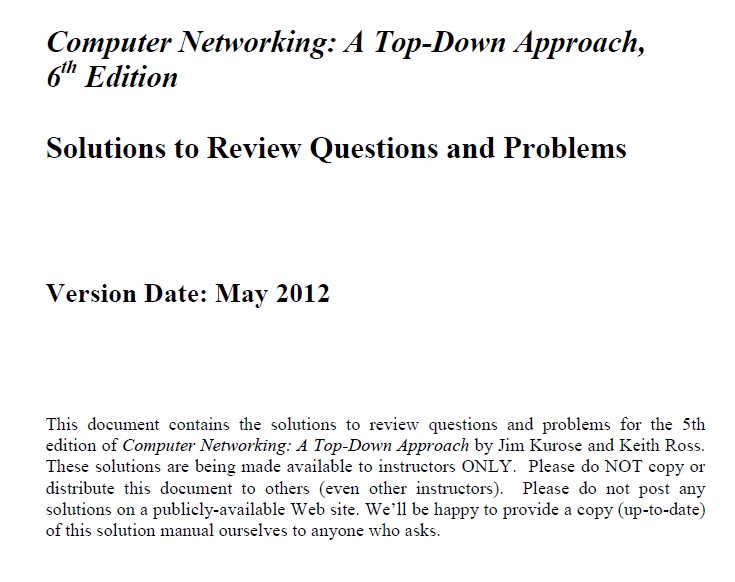
|
| Author description: | James F. Kurose University of Massachusetts, Amherst Keith W. Ross, Polytechnic Institute of NYU |
| Book Download Link : | Download From Main Link Please..!! Click SKIP AD Button if ad appear |
| Book Mirror Download Link : | Download From Mirror Link |
Question is:
Computer Networking Career, Job requirements, salaries, certifications.
Solution is:
What is the requirement to build a career in Computer Networking?
To build a career in computer networking, there are several requirements or responsibilities. From above requirements, below are the main requirements:
1) Computer Engineer has the ability to manage all the user accounts in a network.
2) He has to set the permission and managing system against virus, or he has to ensure the virus protection.
3) Company / Farm will keep a documented list of any network issues and the network engineer has to configure all equipment to fit the system performance.
4) A network Engineer has to create a backup for all systems and monitoring performances.
5) A network Engineer can design the full network and their connection if it is necessary.
Computer networking career jobs in the world:
Computer networking jobs are available in different types of corporation, small business, large business, government farms etc. Computer networking jobs will like this with including the salaries and certifications/ necessary certificate to get the job are given below:
1) Network Administrator:
A network administrator is responsible for designing, installing and managing all of the local area networks and also the wide area networks. Also the internet and intranet systems.
Salary For Network administrator: The average salary for Network administrator job is = $69160 per year.
Necessary Certifications For Network administrator: CISCO's CCNA, CISCO's CCIE, Microsoft's MCT's, CompTIA's Neteork+ etc.
2) Network System Engineer:
A network system Engineer works is to upgrade the security testing and evaluating vendor products. He has to manage the entire network systems.
Salary For Network system engineer: The average salary for network system Engineer job is = $40,000-$90,000 per year.
Necessary Certifications For Network system engineer: CISCO's CCNP, CISCO's CCIE, Wireshark WCNA etc.

3) Network Programmer/Analyst:
A network programmer is responsible for all of the applications by which system can communicate with other. Network programmer writes software scripts or utility programs to help with network, diagnosis and monitoring. He/she also has to evaluate the new software technologies.
Salary For Network programmer: The average salary for Network programmer job is = $49,500-$90,000 per year.
Necessary CertificationsFor Network programmer: CISCO's CCNA, CISCO's CCIE, Microsoft's MCT's, CompTIA's Neteork+ , Juniper JNCIE-ENT etc.
4) Network Information System Manager:
A network system manager is the head of the full networking system or any branch. He will supervise the work of administrators, engineers, programmers.
Salary For Network system manager: The average salary for Network system manager job is = $61,600-$1,20800 per year.
Necessary CertificationsFor Network system manager: CISCO's CCNA, CISCO's CCIE, Microsoft's MCT's, CompTIA's Neteork+ , Juniper JNCIE-ENT, SCMA etc.
Tags: Computer Networking solutions, Computer networking jobs, Computer networking job salaries, Network Engineer job requirements, Computer networking certifications, Computer networking engineer needs
Full Problem is:
What are the layers in the TCP/IP and OSI layers? What are principal of the responsibilities of each of these networks?Solution is:
First, What is the TCP/IP layer:
TCP / IP is a suite of protocols. The acronym TCP / IP stands for "Transmission Control Protocol / Internet Protocol". It comes from the names of the two major protocols of protocol suite, the TCP and IP protocols).
Originally designed for military purpose, the TCP/IP protocol is now the base of the internet. It uses addresses to identify every computer on the network, allowing the safe delivery of data embedded in IP packets. From its military legacy it has retain the following features:
- Splitting messages into packets;
- The use of an address system;
- The routing of network traffic (routing);
- Error checking of data transmission.
What are the layers in the TCP/IP layers and each layers responsibilities:
Each layer of the TCP/IP has a specific capacity to perform and each layer is totally separate from the layer(s) alongside it. The correspondence procedure that happens, at its least difficult between two PCs, is that the information moves from layer 4 to 3 to 2 then to 1 and the data sent touches base at the second framework and moves from 1 to 2 to 3 and after that at last to layer 4.
The application layer is worried with giving system administrations to applications. There are numerous application organize procedures and conventions that work at this layer, including HyperText Exchange Convention (HTTP), Straightforward Mail Transport Convention (SMTP) and Document Exchange Convention (FTP).
At this layer attachments and port numbers are utilized to separate the way and sessions which applications work. Most application layer conventions, particularly on the server side, have uncommonly assigned port numbers, e.g. HTTP = 80 and SMTP = 25, and FTP = 20 (Control), 21 (Information).
Transport Layer
This layer is worried with the transmission of the information. The two fundamental conventions that work at this layer are Transmission Control Convention (TCP) and Client Datagram Convention (UDP). TCP is viewed similar to the dependable transmission convention and it ensures that the best possible information exchange will happen. UDP is not as mind boggling as TCP and in that capacity is not intended to be dependable or ensure information conveyance. UDP is for the most part considered just like a best exertion information conveyance, i.e. once the information is sent, UDP won't do any verifies that it has securely arrived.
The Web Layer
This is the layer that contains the parcel build that will be transmitted. This appears as the Web Convention (IP) which depicts a bundle that contains a source IP Address, goal IP Address and the real information to be conveyed.
Arrange Get to Layer
This is the most minimal level of the TCP/IP convention stack and capacities done here incorporate exemplification of IP parcels into edges for transmission, mapping IP locations to physical equipment addresses (Macintosh Addresses) and the utilization of conventions for the physical transmission of information.
Principal Of OSI models:
The International Organization for Standardization (ISO) is an association that is in charge of the institutionalizing of techniques by which PCs speak with each other. In 1984 the ISO formulated their model for system correspondence. This model is known as the Open Systems Interconnection (OSI) reference model or all the more generally the OSI demonstrate.
The OSI demonstrate partitions organize correspondences into seven layers. Each layer is in charge of completing particular capacities when transmitting information on the system. Each layer of this 7 layer structure has an unmistakable capacity.
These layers can be utilized the accompanying acronyms:
All People Seem To Need Data Processing. (Layers 7 down to 1)
Individuals Do Not Throw Sausage Pizza Away (Layers 1 up to 7)
Each of the letters speaks to an alternate layer (take note of that the request of these layers is basic)
Tags: Computer Networking solutions, TCP/IP protocols, principal of TCP/IP protocols, responsibilities of TCP/IP protocols, OSI models, What are the layers in the TCP/IP and OSI layers? What are principal of the responsibilities of each of these networks?
Problem is:
Describe different types of Packet-Switched Network DelaysSolution is:
There are four major types of delays on each node of a packet-switched network:Processing Delay
When a packet reaches a router, the router reads the header, locates its final destination, and decides which outbound link to send it on. It also may do some transmission error checking. These account for the processing delay.
Queueing Delay
Most routers utilize a first-come-first-serve queue for packet traffic. If traffic on the router is busy, then the packet will have to wait in a queue for its turn to be transmitted by the router. This accounts for the queueing delay.
Transmission Delay
The amount of time it takes a router to push out the next packet on to the link is the transmission delay. This delay is a function of the size of the packet and the transmission rate of the link.
L = packet length
R = transmission rate of link
delay_trans = L / R
Propagation Delay
The amount of time it takes to propagate the packet from the beginning of the link to the next link is the propagation delay. It is a function of the length of the link and the speed of the link.
d = distance of the link
s = speed of the distance
delay_prop = d / s
Tags: Computer networking problem solution, Packet switched, different types of Packet-Switched Network Delays, processing delay, delay
Problem is:
Explain the procedure of DSL Internet Access.Solution is:
DSL Internet Access:Today, the two most prevalent types of broadband residential access are Digital Subscriber Line (DSL) and cable.
A residence typically obtains DSL Internet access from the same local telephone company (telco) that provides its wired local phone access. Thus, when DSL is used, a customer’s telco is also its ISP. As shown in Figure, each customer’s DSL modem uses the existing telephone line to exchange data with a digital subscriber line access multiplexer (DSLAM) located in the telco’s local central office (CO).

The home’s DSL modem takes digital data and translates it to high frequency tones for transmission over telephone wires to the CO; the analog signals from many such houses are translated back into digital format at the DSLAM.
The residential telephone line carries both data and traditional telephone signals simultaneously, which are encoded at different frequencies:
• A high-speed downstream channel, in the 50 kHz to 1 MHz band
• A medium-speed upstream channel, in the 4 kHz to 50 kHz band
• An ordinary two-way telephone channel, in the 0 to 4 kHz band
This approach makes the single DSL link appear as if there were three separate links, so that a telephone call and an Internet connection can share the DSL link at the same time.
The The DSL standards define transmission rates of 12 Mbps downstream and
1.8 Mbps upstream [ITU 1999], and 24 Mbps downstream and 2.5 Mbps upstream [ITU 2003].
Because the downstream and upstream rates are different, the access is said to be asymmetric.
While DSL makes use of the telco’s existing local telephone infrastructure, cable Internet access makes use of the cable television company’s existing cable television infrastructure.
A residence obtains cable Internet access from the same company that provides its cable television. As illustrated in Figure 1.6, fiber optics connects the cable head end to neighborhood-level junctions,
from which traditional coaxial cable is then used to reach individual houses and apartments. Each neighborhood junction typically supports 500 to 5,000 homes.
Because both fiber and coaxial cable are employed in this system, it is often referred to as hybrid fiber coax (HFC).
One important characteristic of cable Internet access is that it is a shared broadcast medium. In particular, every packet sent by the head end travels downstream on every link to every home and every packet sent by a home travels on the upstream channel to the head end.
Tags: Explain the procedure of DSL Internet Access, DSL, internet access, Computer networking solutions
Problem is:
List the different types of Computer network job and related certificate to get this job.Solution is:
Networking jobs are available in a variety of job settings including large corporations, small businesses, professional offices and government organizations.
Network Administrator:
The person with this job title is responsible for designing, installing and managing local area networks and wide area networks, Internet and intranet systems on a day-to-day basis. The median salary for this position is $69,160 per annum.
Certifications - CompTIA's Network+, Cisco's CCNA, and Microsoft's MCTS: Server 2008 Network Infrastructure Configuration.
Network Systems Engineer:
This person focuses on system upgrades, security testing and evaluating vendor products. The salary range for this position ranges from $40,000-$90,900 per year.
Certifications - Security+ or equivalent DOD 8570 IAT Level Certification
Network Service Technician: This technical position is responsible for the set up, troubleshooting and repair of hardware and software issues. Median salaries range from $27,000-$58,000.
Network Programmer/Analyst: This person writes software scripts or utility programs to help with network diagnosis or monitoring. Part of their responsibility may also include evaluating and integrating new software technologies into a new or existing network. Median salaries range from $49,500-$90,000.
Network/Information Systems Manager: This person supervises the work of administrators, engineers, technicians, programmers and analysts. She provides long-range planning and strategies. The average salary for this position is $61,600, and the high end of the salary range is $120,800.
Tags: Computer Networking jobs, Computer networking job salaries, different types of Computer network job, Computer network job,salaries and related certificate to get this job
Problem is:
The objectives and learning outcomes of Computer Network course as a graduate of CSESolution is:
Computer Networking Course Objectives:
At the end of the course, the students will be able to:1. Build an understanding of the fundamental concepts of computer networking.
2. Familiarize the student with the basic taxonomy and terminology of the computer networking area.
3. Introduce the student to advanced networking concepts, preparing the student for entry Advanced courses in computer networking.
4. Allow the student to gain expertise in some specific areas of networking such as the design and maintenance of individual networks.
Computer Networking Course Learning Outcomes:
After completing this course the student must demonstrate the knowledge and ability to:1. Independently understand basic computer network technology.
2. Understand and explain Data Communications System and its components.
3. Identify the different types of network topologies and protocols.
4. Enumerate the layers of the OSI model and TCP/IP. Explain the function(s) of each layer.
5. Identify the different types of network devices and their functions within a network
6. Understand and building the skills of subnetting and routing mechanisms.
7. Familiarity with the basic protocols of computer networks, and how they can be used to assist in network design and implementation.
Tags: Computer Networking problems, Computer Networking course outcomes, computer networking course objectives, Computer networking course,The objectives and learning outcomes of Computer Network course as a graduate of CSE
Problem is:
What is the difference between a virus and a worm?
Solution is:
| Virus | Worm |
|---|---|
| Viruses are malware that require some form of user interaction to infect the user’s device. | Worms are malware that can enter a device without any explicit user interaction |
| A virus must meet two criteria: It must execute itself. It will often place its own code in the path of execution of another program. It must replicate itself. For example, it may replace other executable files with a copy of the virus infected file. Viruses can infect desktop computers and network servers alike. Some viruses are programmed to damage the computer by damaging programs, deleting files, or reformatting the hard disk. Others are not designed to do any damage, but simply to replicate themselves and make their presence known by presenting text, video, and audio messages. | This is in contrast to viruses, which requires the spreading of an infected host file. Although worms generally exist inside of other files, often Word or Excel documents, there is a difference between how worms and viruses use the host file. Usually the worm will release a document that already has the "worm" macro inside the document. The entire document will travel from computer to computer, so the entire document should be considered the worm. |
| The classic example is an e-mail attachment containing malicious executable code. If a user receives and opens such an attachment, the user inadvertently runs the malware on the device. Typically, such email viruses are self-replicating: once executed, the virus may send an identical message with an identical malicious attachment to, for example, every recipient in the user’s address book. | For example, a user may be running a vulnerable network application to which an attacker can send malware. In some cases, without any user intervention, the application may accept the malware from the Internet and run it, creating a worm. The worm in the newly infected device then scans the Internet, searching for other hosts running the same vulnerable network application. When it finds other vulnerable hosts, it sends a copy of itself to those hosts. |
Tags : Computer Networking problems solution, Computer Virus, What is the difference between a virus and a worm?, What is Worm, What is Virus
Full Problem is:
Suppose Host A wants to send a large file to Host B. The path from Host A to Host B has three links, of rates R1 = 500 kbps, R2 = 2 Mbps, and R3 = 1 Mbps.a. Assuming no other traffic in the network, what is the throughput for the file transfer?
b. Suppose the file is 4 million bytes. Dividing the file size by the throughput, roughly how long will it take to transfer the file to Host B?
c. Repeat (a) and (b), but now with R2 reduced to 100 kbps.
Solution of problem is:
a. Assuming no other traffic in the network, what is the throughput for the file transfer?
Solution - Since there is no other traffic in the network, that means file transfar throughput will be - 500kbps
b. Suppose the file is 4 million bytes. Dividing the file size by the throughput, roughly how long will it take to transfer the file to Host B?
Solution -
4 million bytes
= 4000000 bytes
= (4000000 * 8) bits
= 32000000 bits
Now, throughput
= 500 kbps
= (500 * 1000) bps
= 500000 bps
Divide file by throughput
= (32000000 / 500000) second
= 64 seconds
c. Repeat (a) and (b), but now with R2 reduced to 100 kbps.
Solution -
Repeat (a) Since it is now 100 kbps, Ans = 100kbps
Repeat (b)
= (32000000 / 100000) second
= 320 seconds
Tags: Computer Networking solution, Host A to Host B problem solution, large file send to another host, Suppose Host A wants to send a large file to Host B problem solution
Full Problem is:
Some content providers have created their own networks. Describe Google’s network. What motivates content providers to create these networks?Solution of the Problem is:
Describe Google’s network?
Google's private network connects together all its data centers, big and small. Traffic between the Google data centers passes over its private network rather than over the public Internet. Many of these data centers are located in, or close to, lower tier ISPs.Therefore, when Google delivers content to a user, it often can bypass higher tier ISPs.
What motivates content providers to create these networks?
- First, the content provider has more control over the user experience, since it has to use few intermediary ISPs.
- Second, it can save money by sending less traffic into provider networks.
- Third, if ISPs decide to charge more money to highly profitable content providers (in countries where net neutrality doesn't apply), the content providers can avoid these extra payments.
Tags: Computer networking solution,Describe Google’s network, What motivates content providers to create these networks, Content providers benefit
Full Problem is:
What advantage does a circuit-switched network have over a packet-switched network?What advantages does TDM have over FDM in a circuit-switched network?
Solution is:
A circuit-switched network can guarantee a certain amount of end-to-end bandwidth for the duration of a call.But in most packet-switched networks today (including the Internet) cannot make any end-to-end guarantees for bandwidth.
This is the main advantage of circuit-switched network over a packet switched network.
FDM requires sophisticated analog hardware to shift signal into appropriate frequency bands but TDM doesn't require that sophisticated analog hardware to shift signal.
Tags: Computer networking solutions, advantage does a circuit-switched network, packet switched network, FDM, TDM, bandwidth
Problem is:
Describe the most popular wireless Internet access technologies today. Compare and contrast them.Solutions is:
There are two popular wireless Internet access technologies today. They are Wifi and 3G,4G. Descriptions are below:
a) Wifi (802.11)
In a wireless LAN, wireless users transmit/receive packets to/from a base station (i.e., wireless access point) within a radius of few tens of meters. The base station is typically connected to the wired Internet and thus serves to connect wireless users to the wired network.
b) 3G and 4G wide-area wireless access networks:
In these systems, packets are transmitted over the same wireless infrastructure used for cellular telephony, with the base station thus being managed by a telecommunications provider. This provides wireless access to users within a radius of tens of kilometers of the base station.
Tags: Computer Networking Problem solutions, most popular wireless Internet access technologies, Wifi, 3G, internet access, compare between Wifi and 3G
Full Problem is:
Dial-up modems, HFC, DSL and FTTH are all used for residential access. For each of these access technologies, provide a range of transmission rates and comment on whether the transmission rate is shared or dedicated.Solution of the Problem:
Dial up modems:
up to 56 Kbps,
bandwidth is dedicated;
ADSL:
up to 24 Mbps downstream
and 2.5 Mbps upstream
bandwidth is dedicated;
HFC:
Downstream rates up to 42.8 Mbps
and upstream rates of up to 30.7 Mbps
bandwidth is shared.
FTTH:
2-10 Mbps upload;
10-20 Mbps download;
bandwidth is not shared.
Tags: Computer Networking solutions, Dial up modems range of transmission, Dial up modems speed, Dial-up modems, HFC, DSL and FTTH are all used for residential access. For each of these access technologies, provide a range of transmission rates and comment on whether the transmission rate is shared or dedicated
Problem is :
What is Ethernet LANs and transmission rate of Ethernet LANs?Solution is:
So, first one what is Ethernet LANs?From LifeWire we get what is Ethernet :
Ethernet is the name of the most commonly used LAN today. A LAN (Local Area Network) is a network of computers that covers a small area like a room, an office, a building or a campus. It is used in contrast with WAN (wide area network) which spans for much larger geographical areas. Ethernet is a network protocol that controls how data is transmitted over a LAN. Technically it is referred to as the IEEE 802.3 protocol.
And the second problem - transmission rate of Ethernet LANs:
Solution - Ethernet LANs have transmission rates of 10 Mbps, 100 Mbps, 1 Gbps and 10 Gbps.
Tags: Computer Networking Solutions, Ethernet LANs, What is Ethernet LAN, Ethernet, transmission rate of Ethernet,
Full Problem is:
Is HFC transmission rate dedicated or shared among users? Are collisions possible in a downstream HFC channel? Why or why not?Solutions of this problem:
First, we need to know what is HFC? From Wikipedia we know that-
Hybrid fiber-coaxial (HFC) is a telecommunications industry term for a broadband network that combines optical fiber and coaxial cable.It has been commonly employed globally by cable television operators since the early 1990s. In a hybrid fiber-coaxial cable system, the television channels are sent from the cable system's distribution facility, the headend, to local communities through optical fiber subscriber lines.
At the local community, a box called an optical node translates the signal from a light beam to electrical signal, and sends it over coaxial cable lines for distribution to subscriber residences. The fiberoptic trunk lines provide adequate bandwidth to allow future expansion and new bandwidth-intensive services.
Come to solution:
On the downstream channel, all packets emanate from a single source, namely, the head end. Thus, there are no collisions in the downstream channel.
Tags: Computer Networking Solutions, What is HFC, HFC transmission rate, Are collisions possible in a downstream HFC channel,
Full Problem is:
List six access technologies. Classify each one as home access, enterprise access, or wide-area wireless access.Solution of this problem is:
1. Dial-up modem over telephone line: Dial up modem is a home access technology.
2. DSL over telephone line: DSL is a home or small office access technology.
3. Cable to HFC: Cable to HFC is a home access technology.
4. 100 Mbps switched Ethernet: Cable to ethernet is an enterprise access technology.
5. Wifi (802.11): Wifi is a home and enterprise access technology;
6. 3G and 4G: 3G and 4G are wide-area wireless access technology.
Tags: Computer Networking solutions, access technologies, home access technology, List six access technologies
Subscribe to:
Posts
(
Atom
)


